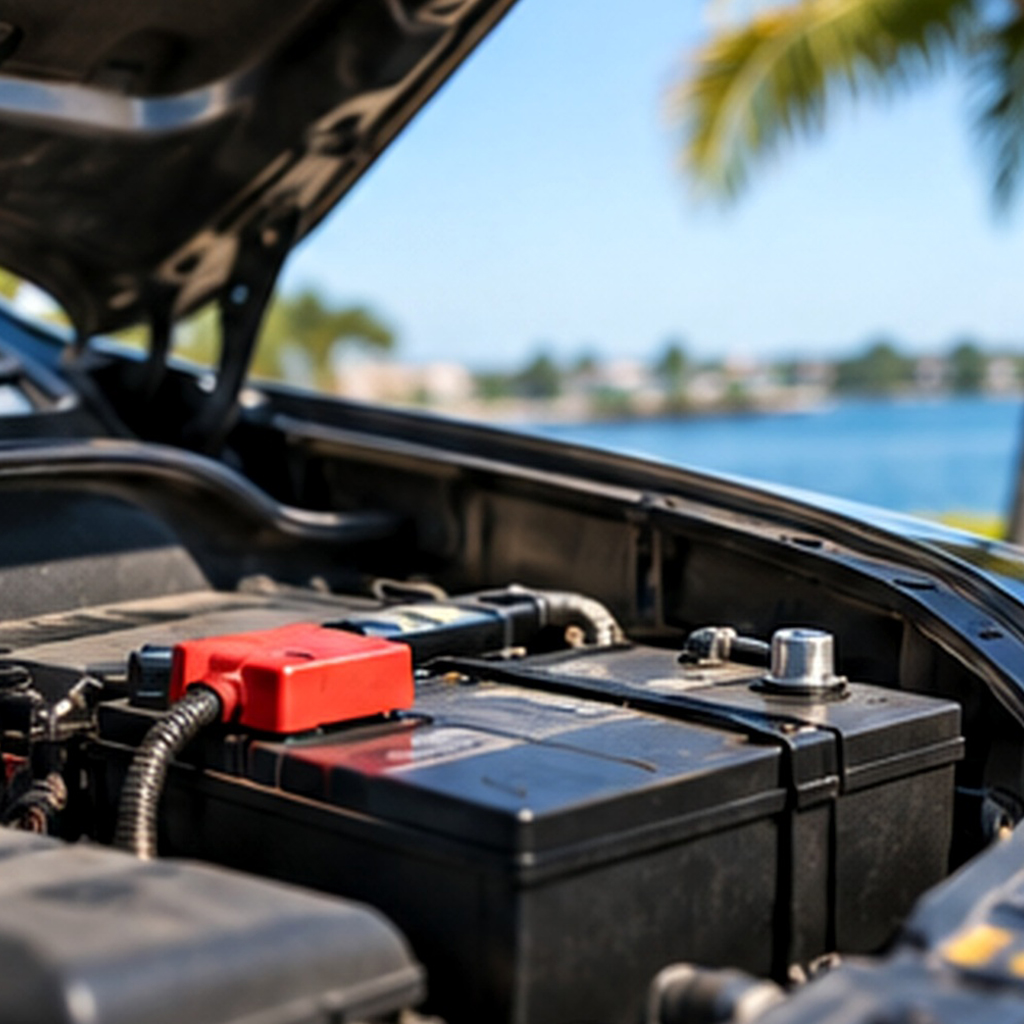
The Snowbird Return: What Happens to a Car Battery During Months of Storage
For many seasonal residents, returning to Naples begins with familiar routines: opening the house, checking the air conditioning, and getting the car ready for errands. The vehicle may look exactly as it did when it was parked months earlier. The tires are still in place, the interior is untouched, and the keys are waiting. But the battery has been aging through every week of that absence.
A car does not need to be driven for its battery to change. Long storage, ordinary electrical demands, and Southwest Florida’s warm climate can affect how much starting power remains when the owner returns. The first successful start is not always proof that the battery is healthy. Understanding what happened while the car was parked can make the first days back far less stressful.
1. Parking Stops the Engine, Not the Passage of Time
A conventional 12 volt car battery slowly loses charge even when it is disconnected from a vehicle. When installed, it may also support legitimate standby functions such as security systems, clocks, and other electronic memory. The amount varies by vehicle and its condition. In normal daily use, the charging system helps replenish energy while the engine operates. During extended storage, that replenishment may not happen at all.
As the state of charge decreases, the battery can become less capable of supplying the high current needed to start the engine. Long periods at a low state of charge can also contribute to deterioration in lead acid batteries. That is why a vehicle parked for months deserves more attention than a car that sat for a single weekend.
2. A Battery Can Be Weak Without Looking Damaged
Some battery problems are visible, including a swollen case, fluid leakage, or damaged connections. Low charge and reduced capacity, however, often leave no obvious external clues. The battery can appear clean and still struggle when the starter demands a large burst of power. A car may also start once and fail later after another stop.
This distinction matters because a jump start and a battery replacement solve different problems. A jump start supplies temporary assistance to start the engine. It does not repair an aged battery, restore lost capacity, or establish why the charge became low. A battery that repeatedly needs a boost should be evaluated rather than treated as a permanent jump start routine.
3. Southwest Florida Storage Is Not the Same as Winter Storage Up North
People often associate battery failures with cold mornings, but Naples presents another challenge. Heat can accelerate battery deterioration even when the vehicle is parked and unused. A vehicle stored through warm months may return to service with a battery that has experienced both extended inactivity and elevated temperatures.
That does not mean every summer stored vehicle will need a new battery. Age, battery design, charging history, storage conditions, and the vehicle’s standby electrical load all affect the outcome. The important point is to avoid assuming that a mild November morning guarantees an easy start. The battery’s condition reflects its entire history, not just the weather on the day the driver returns.
4. Before Turning the Key, Look for Reasons to Stop
After a long absence, take a moment to inspect the vehicle before attempting to start it. Check for obvious signs of damage around the battery area if it is safely accessible. Look for a cracked or distorted battery case, fluid leakage, severely damaged cable connections, or unusual deterioration. Check the surroundings for signs that pests may have entered the engine compartment. Do not reach near moving parts or disturb unfamiliar electrical components.
If a battery is swollen, leaking, excessively hot, or emitting an unusual strong odor, do not attempt to charge or jump start it. Seek professional assistance. Lead acid batteries contain hazardous materials and can produce explosive gases under some conditions. Safety comes before finding a quick way to get the engine running.
5. Listen to What the First Start Is Telling You
When a vehicle is safe to start, the way it responds may provide clues. A slow crank, repeated clicking, or unusual difficulty turning the engine over can be associated with insufficient starting power. Dim interior lighting or electrical systems that reset during an attempt may also suggest a low voltage condition. These symptoms are not a definitive diagnosis, because starter motors, connections, and other components can cause similar behavior.
Resist the temptation to make repeated start attempts if the engine is barely turning. Continuing to crank can drain a weakened battery further. It is more useful to identify whether the battery needs charging, testing, or professional attention before another attempt is made.
6. One Short Drive May Not Replace Months of Lost Charge
After a successful start, some drivers assume that a trip around the block will return the battery to full charge. In reality, charging depends on the battery’s condition, its starting state of charge, the vehicle’s charging strategy, electrical demand, and the duration of operation. A brief errand may not replace the energy required after a long period of inactivity.
This is one reason battery testing and appropriate charging can be more informative than simply checking whether the engine starts. If the vehicle needed assistance to start after storage, a technician can help determine whether the battery is recoverable, whether it can hold sufficient charge, and whether another issue needs attention. Driving alone should not be treated as a guaranteed solution for a deeply discharged battery.
7. A Battery Maintainer Can Be Useful, but Compatibility Matters
Owners who plan for extended storage may benefit from a quality automatic battery maintainer, provided the vehicle manufacturer permits it and the device is compatible with the installed battery. A maintainer is designed to help preserve charge while the vehicle is parked. It is not the same as using an uncontrolled charger indefinitely. The vehicle manual should guide connection points, permitted equipment, and storage procedures.
Battery types require different charging approaches. A charger suitable for one battery chemistry may not be suitable for another, and some vehicles have special procedures or electrical management systems. Use approved equipment, follow the safety instructions, and avoid improvised electrical connections. If there is no safe power supply at the storage location, ask a qualified professional about options for that particular vehicle rather than automatically disconnecting the battery. Disconnecting can affect some security, memory, and electronic functions.
8. Hybrid and Electric Vehicles Need Their Own Storage Plan
Hybrid and electric vehicles can have both a high voltage traction battery and a separate low voltage battery that supports essential control systems. The relationship between those systems differs by manufacturer and model. A low voltage battery problem can sometimes prevent a vehicle from becoming ready to drive, even when the main battery has energy remaining.
Long term storage instructions for these vehicles can vary significantly. Some manufacturers recommend particular charge levels or specific charging arrangements. The safest approach is to follow the exact owner’s manual and seek qualified assistance when needed. Never attempt to access or service high voltage components as part of an ordinary battery check.
9. Make a Return Plan Before the First Important Drive
The worst time to discover a weak battery is when leaving for a medical appointment, airport pickup, or an evening event. Seasonal residents can reduce that risk by checking vehicle readiness before their first demanding day back. If someone is responsible for maintaining the vehicle during an absence, agree in advance on what inspections and charging procedures are appropriate instead of relying on occasional, very short engine starts.
When returning, allow time to review the battery’s condition, tires, visible fluid leaks, and other basic vehicle safety concerns. If the car has been parked for many months, consider a maintenance inspection before a longer trip. For drivers in the Naples area who encounter a no start situation, Car Battery Naples lists mobile jump start and mobile battery replacement among its roadside services. Getting assistance can be safer than repeatedly experimenting with a battery whose condition is unknown.
10. Think Ahead to the Next Departure
The best storage plan starts before a vehicle is left behind. Record the age and condition of the battery, consult the owner’s manual, decide how charge will be maintained, and check that the storage environment is suitable. If a battery is already weak at departure, several months of inactivity are unlikely to improve it. Addressing concerns before leaving gives the vehicle a better chance of being ready when the season changes again.
Battery care is not about guaranteeing that nothing will ever fail. It is about understanding a predictable risk and choosing reasonable precautions. For seasonal residents, that preparation belongs on the departure checklist alongside securing the house and arranging property maintenance.
Conclusion
A parked car can look as though time has stood still, but its battery has been living through the months just like the rest of the vehicle. The first drive back in Southwest Florida should begin with an understanding of that hidden history, not an assumption that silence means everything is fine. A little attention before and after storage can turn an uncertain first start into a more confident return to the road.